Image

The University of Virginia School of Data Science welcomed over 300 participants for Datapalooza 2026, the annual signature event that showcases research, education, and industry trends across Grounds and beyond.
This year’s event focused on “The Future of Work, Powered by Data and People,” and included a keynote panel, three breakout sessions, a fireside chat, and multiple networking opportunities.
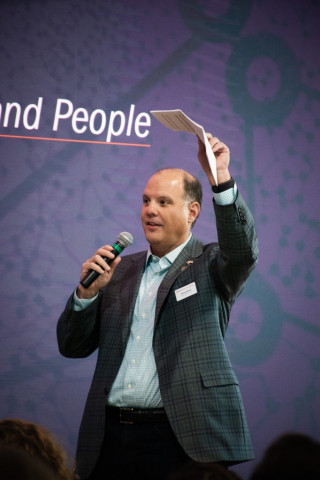
Jeffrey D. Blume, the interim Stephenson Dean for the School of Data Science, welcomed guests in the Capital One Hub of the new data science building. He opened by thanking the School of Data Science industry partners: General Atomics Intelligence, LMI, Capital One, NobleReach Foundation, and Mace AI. “Their support and collaboration helped make this event possible, and they really strengthened the connections between the University, industry, and the broader community.”
Blume spoke about the transformational change that has taken place since the School’s first Datapalooza in 2015. “I don’t think any of us could have fully anticipated how quickly the field has evolved or how profoundly data and artificial intelligence would change the way we live and work,” he said.
As AI becomes increasingly integrated into the workplace, Blume emphasized that technological advances alone are not enough to drive meaningful progress.
“We need people who can question assumptions, evaluate evidence, recognize bias, and understand the consequences of the decisions we make.” That responsibility, Blume noted, is central to the School’s mission.
“Our work is grounded in rigorous inquiry, thoughtful judgment, and a commitment to making a meaningful difference in the world,” he said.
Following the welcome address, a keynote panel explored how data science has changed as a result of rapid technological advancement and where humans fit in.

Panelists included three experienced industry leaders, moderated by Miriam Friedel, a data science professor of practice and former vice president of machine learning at Capital One.
Friedel pointed out that the common thread connecting all participants was an emphasis on data and people. She asked panelists to discuss recent changes from the AI boom and how it’s affected the way we work.
Arun Gupta, CEO of NobleReach Foundation, said that working with AI requires a new mindset. “You’ve got the most powerful tool you’ve ever had that can help you get to the right answer,” he said, “but if you haven’t asked the right question, it doesn’t really matter.”
The conversation also included advice for students entering the workforce. Friedel asked panelists to explain how recent changes to the field are affecting entry-level positions.
Gupta felt more pressure will be on mid-career employees because younger people tend to be more willing to experiment and try new things. With AI, he said, “you’re going to have 25-year-olds with the expertise of a 40-year-old.”
While Reggie Aggarwal, founder and CEO of Cvent, agreed that young people are more agile, he pointed out that it can be harder to get a job when you’re early in your career because you need practical life experience. “In the end, it’s opportunity for the people who seize it,” Aggarwal offered. “It is an opportunity, but if you don’t move fast, it’s going to negatively impact your career.”
Aggarwal encouraged students to develop skills in building AI agents, pointing to agentic AI as the next major technological advancement. “At the end of the day, generative AI is important, but it’s really what comes after it. … Agentic is one of the biggest things that is going to happen,” he said.
Scott Stephenson, founder of SGS Capital and former CEO and chairman of Verisk Analytics, was very optimistic about the future. “People who used to be just about generating code are like mini chief technology officers,” he said. “I personally believe the future of work is going to be great. The opportunity to be explosively creative is here.”
Following the keynote panel, the program offered three breakout sessions.
“How Do You Become a Data Science Leader?” featured Ramesh Durvasula, chief data officer at Roche, and Lexi Reese, co-founder and CEO of Lanai. Prince Afriyie, associate professor of data science and director of the undergraduate program, moderated the discussion.
Both speakers emphasized that AI is transforming workplace tasks and raising expectations for employees.
Durvasula described growing demand for professionals who understand both AI and fields such as chemistry, biology, manufacturing, and business. "That's what we're looking for: bilingual people,” he said. “You're skilled in AI, and you're skilled in a topic — not AI — in a subject matter that matters to the industry that you're in." He stressed that technical proficiency alone is insufficient without the context needed to apply it meaningfully.
Both speakers also discussed AI’s place in our lives, saying that foundational learning should come before relying on AI.
Reese argued that students should spend their first year developing core intellectual skills without AI assistance. Durvasula emphasized that AI could make recommendations, but humans must retain responsibility for consequential decisions, particularly in healthcare.

In the breakout session “What Do You Really Want to Know About Working in Data Science?” industry and academic professionals explored what it takes to succeed in a field increasingly shaped by AI. Moving beyond technical skills, panelists discussed what employers look for in candidates, how professionals build expertise, and why human judgment remains essential in an AI-driven workplace.
Kane Geyer, principal at PwC, emphasized the value of balancing specialized expertise with broader knowledge across disciplines. Drawing on his experience managing a team of 250 people, he explained how career advancement often requires understanding the work of others and communicating technical ideas effectively. He also warned against an “AI echo chamber,” in which overreliance on AI could weaken critical thinking and debate.
Laura Ipsen, president and CEO of Ellucian, highlighted curiosity as a key quality in job candidates, noting that the questions candidates ask during interviews can be as revealing as their answers. She encouraged students to acknowledge what they don’t know and demonstrate how they would find answers. Ipsen also raised concerns about managing AI agents, including protecting intellectual property, controlling data access, and maintaining accountability.
Stephen Turner, associate professor of data science and assistant dean for research at the School of Data Science, encouraged students to develop expertise while understanding that their work creates value. On AI, he compared agents to interns whose work requires verification and oversight. He also raised ethical concerns about autonomous weapons and the responsible use of technology.

Another breakout session “How Can a Technologist Create and Innovate?” featured three industry executives with Brian Wright, Quantitative Foundation Associate Professor of Data Science, serving as moderator.
Speakers agreed that innovation should solve a real problem, not just showcase technology. Each executive gave different advice for students and professionals.
Jennifer Langton, the founder and CEO of Jennifer Langton Inc., spent 15 years at the NFL, where she became an executive and led a major safety transformation. She stressed the importance of understanding client needs and building trust.
“If you can’t connect to the human in terms of why it’s good for them, address their fears and make it better, you’re going to fail,” she said. She described her process of reducing concussions on the field by using game footage to count head impacts and build algorithms, using data that hadn’t previously been recorded to help significantly reduce concussions.
Federico Cohen Freue, executive vice president of AI and data operations at Mastercard, emphasized the importance of diverse perspectives in decision-making. “You need diversity of thought to make decisions. You shouldn’t do it by yourself.”
He also stressed that even the best analysis has little value unless it influences action. “You can have the best analysis in the world with the best customer data, but if it doesn’t actually change the way someone does something … it doesn’t matter.”
Patrick Harrison, principal AI consultant at Data Theoretic and former data science leader at S&P Global, encouraged students to pair data science with another discipline. “Specialize in something. Pick an area, pick an industry, pick a type of data, learn a lot of that and get really good so you can understand the results of your analysis,” he said.

Datapalooza concluded with a Fireside Chat featuring panelists Miranda Bogen, chief technologist and director of the AI Governance Lab at the Center for Democracy and Technology, and Ned Gallaway, chair of Albemarle County's Board of Supervisors. Siri Russell, associate dean for Community and Government Partnerships, moderated the discussion.
Gallaway, who represents the Rio district of Albemarle County and is serving a three-year term, cautioned that AI can process vast amounts of information without providing context or verification needed for sound decisions: “You don’t want AI to write your local ordinances. It can and it will if you ask it to, but is that what you really want?”
Bogen, whose career began in civil rights, raised concerns about AI’s implications for privacy, freedom of expression, and democracy. She warned that increasingly sophisticated AI systems enable the government to collect and analyze vast amounts of personal data, potentially threatening civil liberties. “We have to think about how the government might exploit the data they have,” she said, referencing Flock cameras and data collected at the border.
Arlyn Burgess, the School’s associate dean for administration, provided closing remarks, thanking industry partners, this year’s co-chairs, Sarah Rogis and Mona Sloane, event coordinator Ashlynne Alber, as well as speakers and moderators.
“Datapalooza is about more than sharing research and showcasing innovation. More than anything, it’s about bringing people together,” Burgess said. “I hope you all leave here today with new insights, new connections, and excitement for what the future brings.”

Subscribe to receive updates from the School of Data Science.


