Image


The University of Virginia School of Data Science recently hosted the annual Ph.D. in Data Science Research Showcase, bringing together students, faculty, and staff to celebrate their summer research endeavors. The event featured a mix of 11 oral presentations and 27 poster presentations, offering attendees a chance to engage with students and explore the wide-ranging applications of their work.
From advances in healthcare and climate modeling to innovations in artificial intelligence, cybersecurity, and social equity, the projects underscored the School’s mission to practice responsible data science for the common good.
“This showcase is an opportunity not only for our students to practice presenting their research, but also for the broader data science community to see the incredible work being done across the School,” said Tom Stewart, program director of the Ph.D. in Data Science.
Students practiced their communication skills in brief oral presentations, highlighting how they are pushing the boundaries of data science across multiple domains. Projects included using machine learning to improve cancer detection, building predictive models for environmental sustainability, developing tools to support more equitable decision-making in public policy, and enhancing natural language processing for multilingual contexts.
“What really distinguishes our program is the intentional, holistic curriculum and an interdisciplinary focus that emphasizes both rigorous research and practice-focused application,” Stewart said. “That blend prepares our students to communicate their work at the technical level and for general audiences alike.”
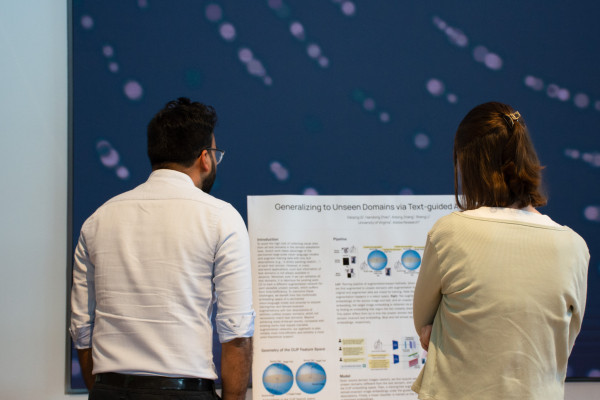
The afternoon poster session gave all attendees an opportunity to engage directly with students, ask questions, and explore research in greater depth. Many of the posters revealed collaborations with disciplines across the University — including medicine, engineering, business, education, and the social sciences — demonstrating the “School Without Walls” ethos.
Dean Phil Bourne addressed the students and commended them for their ability to bring together different disciplines through data methods. “That interdisciplinary crossover is not only our strength; it’s the future.”
The breadth of research also reflected how the program is preparing the next generation of scholars to apply data science for the greater good, whether by improving health outcomes, promoting fairness and accountability, protecting the environment, or advancing technology that benefits society.
“The energy, creativity, and rigor on display at this year’s showcase were remarkable,” said Stephen Turner, assistant dean for research at the School of Data Science. He emphasized that the Ph.D. students are pushing the boundaries of data science in ways that will have a real and lasting impact. “What struck me most was the incredible breadth of research: projects spanning medicine, physics, AI, computer vision, energy, sports, public policy, and more. It’s a real testament to the collaborative, interdisciplinary spirit that defines data science at UVA.”
The showcase concluded with an award ceremony, including student- and faculty-nominated awards.
Awards nominated by students
Showcase awards nominated by faculty
Attendees left with a strong sense of momentum and purpose, as students and faculty looked ahead to how data science can confront some of the world’s most urgent challenges.
Dean Bourne reflected on his five decades of research, calling this “a moment like no other — both in terms of the methodologies now available, like large language models, and the data itself.” He praised the students’ engagement and urged them to think boldly about the future and the impact their work can have on society, reminding them that the true measure of their scholarship will be how it advances knowledge and serves the common good.
Subscribe to receive updates from the School of Data Science.