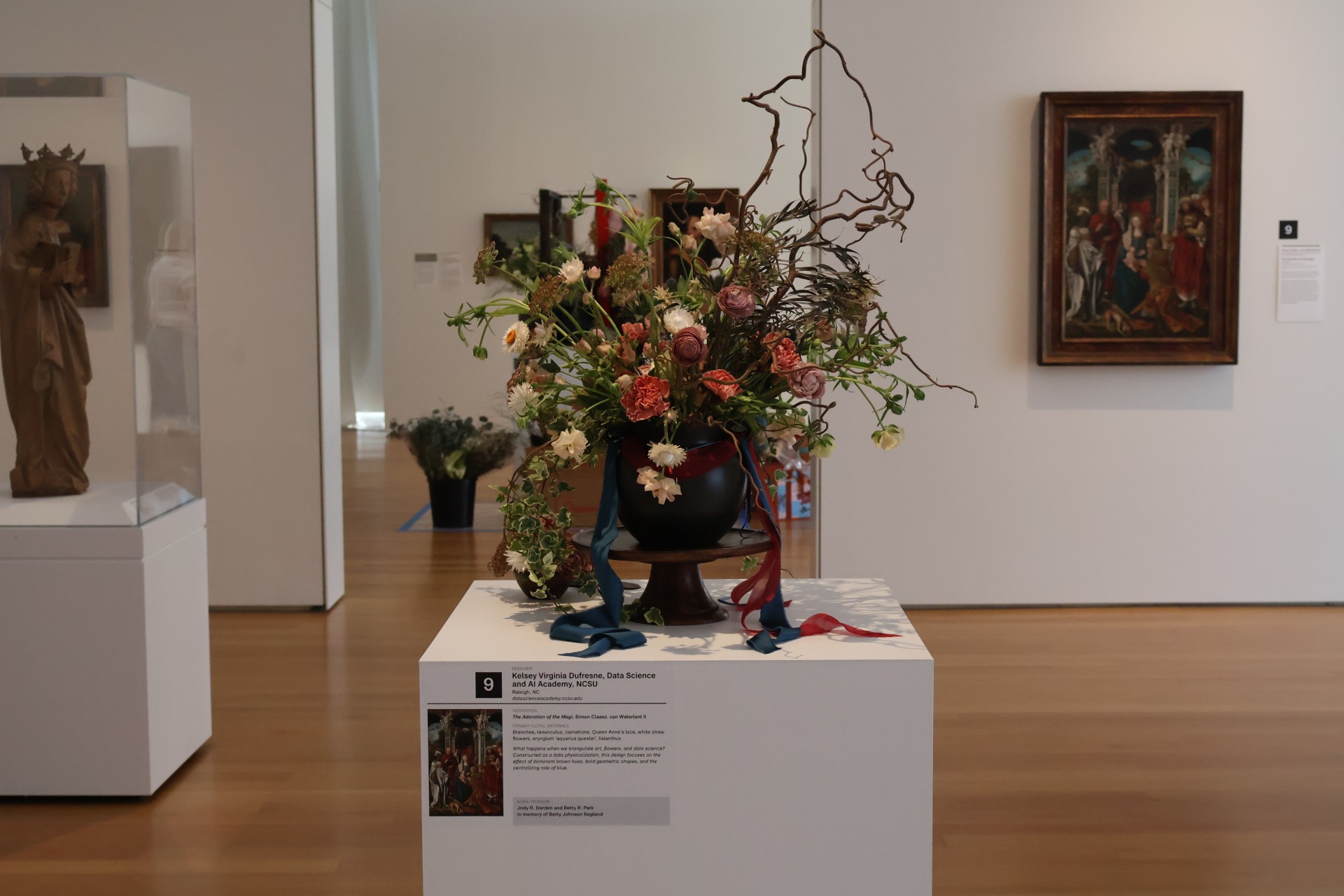
Data in Bloom
Designed as a data-inspired floral physicalization of Simon Claasz. van Waterlant II’s "The Adoration of the Magi," this work was developed for North Carolina Museum of Art's Art in Bloom — the one week a year where NCMA brings nature into its galleries and places flowers on display throughout its exhibits. With dozens of floral arrangements designed to accompany different art pieces throughout the Museum, the event, and this piece more pointedly, challenges traditional expectations of how to engage with art and with data, and what counts as both.
The original floral piece was created by looking to both qualitative and quantitative data, including the most physically present colors, the motifs, the shapes, the composition, and more. In doing so, this work explored the parallels between art and data, how the organic, variated, scented, perishable flowers juxtapose them both, and how data points signify a moment, a story to be told, something to be analyzed and considered.
This arrangement today was created in collaboration with and support from Hope Henderson of Floral Charlottesville based upon the original floral arrangement made in 2025.


Kelsey Virginia Dufresne
Kelsey Dufresne (she/her) grew up across the United States and landed in North Carolina among cicadas, willow oaks, and dogwoods.
After studying English education and American literature at NC State University, Dufresne continued exploring the capacity of experiential learning — asking questions like: What is to be gained when we shift focus to the process and the doing? What happens when we bring two different, seemingly unrelated concepts or components together? What can we learn from them individually and together? Inspired by Ophelia's empowered use of flowers in Shakespeare's Hamlet and Sylvia Plath's incorporation of tulips into her poetry, Dufresne explored flowers as media — especially when held in conversation with art. This interest carried into her work with data science, where she explored interdisciplinary, multimodal, and arts-informed ways to engage with data.
Dufresne still resides in North Carolina with her family of many boys, where she teaches English at UNC Chapel Hill and creates with her children — who especially love watercolors, stickers, and glitter glue.
Read the NC State University article for more information about Dufresne's floral installation, her inspiration, and her journey.
