Image


In this conversation we dive into the complexities of understanding human trafficking and the role AI is playing to help law enforcement identify traffickers and their victims.
Our guests are Kimberly Adams, who leads the strategic architecture of AINA Tech, and Shweta Jain, AINA’s Co-Founder and Technical Architect, whose background in digital forensics and cybersecurity shapes the system’s design.
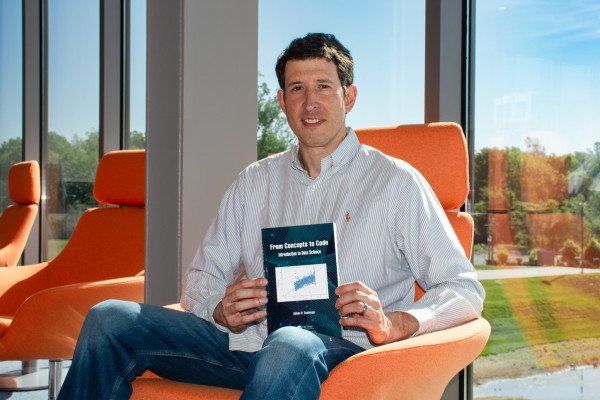
The conversation is led by Adam Tashman, associate professor of data science at UVA. Together, they discuss designing AI for defensibility, integrity, and institutional trust.
Adam Tashman is an associate professor of data science, director of the Data Science Capstone program, and former director of the Online M.S. in Data Science program. Courses he teaches include reinforcement learning, distributed computing, programming for data science, mathematical finance, actuarial statistics, probability and statistics, and survival analysis. Research interests include AI in personalized medicine, digital health, computer vision, large language models, and quantitative finance.
Kimberly Adams leads the strategic framing and execution architecture of AINA Tech. Her work focuses on building AI systems that can withstand legal and institutional scrutiny, particularly in high-stakes environments such as human trafficking investigations. She has worked alongside DOJ-funded task forces and engaged with federal stakeholders to translate governance, procurement, and evidentiary requirements into system design constraints. Through programs such as NSF I-Corps and collaborations with academic partners, she structures how AINA retires institutional risk before deployment.
Shweta Jain leads the technical architecture of AINA, focusing on defensibility, constrained inference, and system integrity. Her background in digital forensics and cybersecurity informs the development of AI systems designed to operate under evidentiary standards. She oversees the rigor, feasibility, and long-term survivability of AINA’s core architecture. She is chair of the Department of Mathematics & Computer Science at John Jay College, an NSA-designated Center of Academic Excellence in Cyber Defense.
AINA Tech, the company that our podcast guests represent, has partnered with UVA for various capstone projects. Here is an explanation of what capstone projects are and what they entail.
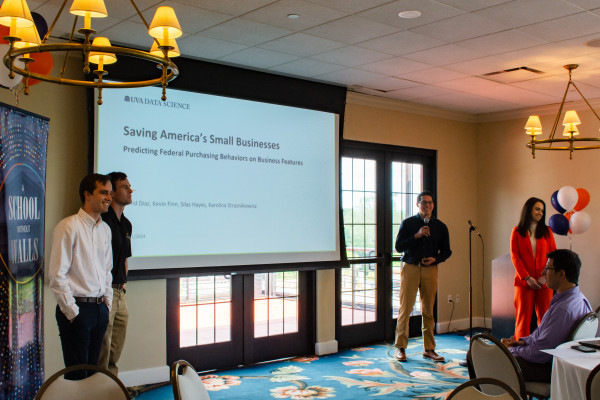
M.S. in Data Science students are required to complete a capstone project. Capstone projects challenge students to acquire and analyze data to solve real-world problems. Project teams consist of two to four students and a faculty advisor. Teams select their capstone project at the beginning of the year and work on the project over the course of two semesters.
Most projects are sponsored by an organization, academic, commercial, non-profit, and government, seeking valuable recommendations to address strategic and operational issues. Depending on the needs of the sponsor, teams may develop web-based applications that can support ongoing decision-making. The capstone project concludes with a paper and presentation.
In the podcast Adam Tashman discusses the 4+1 model at the School of Data Science. We loosely group activities into four domains: analytics, systems, design, and data + society, which are all applied in a fifth domain called practice. Our white paper details the motivation and need for the Domains of Data Science model and traces its origins, which date back decades.
The domains are intended to broadly encompass areas of focus in data science that are related in fundamental ways. Faculty research often spans more than one domain and is interdisciplinary in nature. Much of our research uses statistical, computational, and philosophical principles to enhance ongoing collaborations in biomedical science, engineering, education, business, imaging, and other fields.
Subscribe to receive updates from the School of Data Science.