Image
Education
M.S. in Data Science 2026,
University of Virginia
B.S. in Astronomy-Physics 2025, University of Virginia
Hometown
Hampton, NH
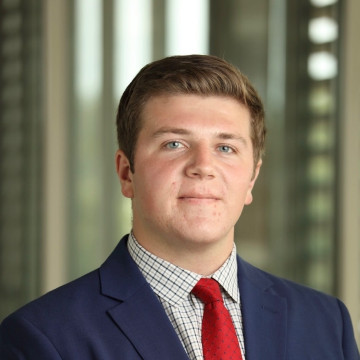
Lucas Rayder did not set out to be a data science student. As an Astronomy-Physics major, his eyes were fixed on the stars — namely, the Small Magellanic Cloud, a dwarf galaxy around 200,000 light-years from Earth.
But data science started calling to him — first when fellow students' coding projects piqued his interests and later when he realized that the work he was doing could benefit from a solid foundation in the field.
Now, as he prepares to join the Space Force, Rayder credits the M.S. in Data Science (MSDS) in-person, residential program with getting him there. Read on to learn what he valued most about the MSDS program, and how he plans to put his degree to work for the greater good.
During my time as an undergraduate at UVA, I worked as a resident advisor alongside people in the MSDS program. I'd occasionally stop by their rooms and catch glimpses of their code, which led me to ask about their projects, and I was hooked by how interesting it all seemed.
The summer between my third and fourth year, I worked with two professors at James Madison University on a neural network for predicting particle interactions at Jefferson Lab. I was definitely in over my head, but I loved it and became determined to develop deeper skills in that area.
By my fourth year, I was enjoying my senior thesis (which I’m currently working to publish soon), but I wanted to work on something with more immediate impact. Then in January 2025, I met a former UVA astronomy Ph.D. student who'd transitioned into data science. He walked me through his work, and it was exactly the kind of meaningful, impactful work I wanted to do. What really struck me was how closely his career path matched mine. His research even covered the same galaxy as my thesis. In that conversation, I realized this was actually a viable path for me, and that's what finally motivated me to apply for the UVA MSDS program.
This fall, I’ll be working as a program analyst for the Space Force, which will allow me to pursue my goal of using my education to benefit society in the near-term. I hope to work on projects that utilize our resources in space to improve safety and security for not just the United States, but the entire world. The Space Force is also a very new organization, so I hope to contribute to forming a data-driven, scientifically informed culture that lasts.
What surprised me most about the MSDS program is how cohesive the cohort feels. My friends from earlier cohorts graduated when the program was much smaller, and I worried that a 90-person cohort couldn't maintain the same warm, supportive culture. But I was wrong. The program creates plenty of opportunities to connect, and several classes encourage collaboration that naturally builds relationships. I genuinely feel like I know everyone at least a little bit.
Outside of class, I’m a part of the Graduate Data Science Council as one of the Student Events and Activities co-chairs. We plan events to help bring the cohort closer together, as well as gathering feedback to improve the program. I was also a teaching assistant for multivariable calculus during the school year, where I got a refresher on some math I enjoy but isn’t quite as relevant in data science.
My advice would be to be informed and believe in yourself. I say to be informed because pursuing this degree is definitely a commitment, and I would make sure the careers you’re interested in truly require it. Make sure you have the time, and that it’s right for you. On the other hand, I say to believe in yourself, because if it does help with your career goals, and you’re able to commit yourself, I wouldn’t let difficulty hold you back. The program can certainly be hard, but there is lots of support, and even people without a technical/coding background can succeed.
I came to UVA partly because my dad is the proudest Cavalier I’ve ever met. He played football here from 1979-83 and he hasn’t stopped wearing blue and orange since. But after this program, I’ll have him beat with two degrees from UVA as opposed to his single one, so I’m pretty proud about that.
Learn more about the full-time, in-person Residential MSDS at the University of Virginia. Request more information, connect with Admissions, or start your application today.
Subscribe to receive updates from the School of Data Science.