Connected Data Hub presents research on how boards shape university presidencies
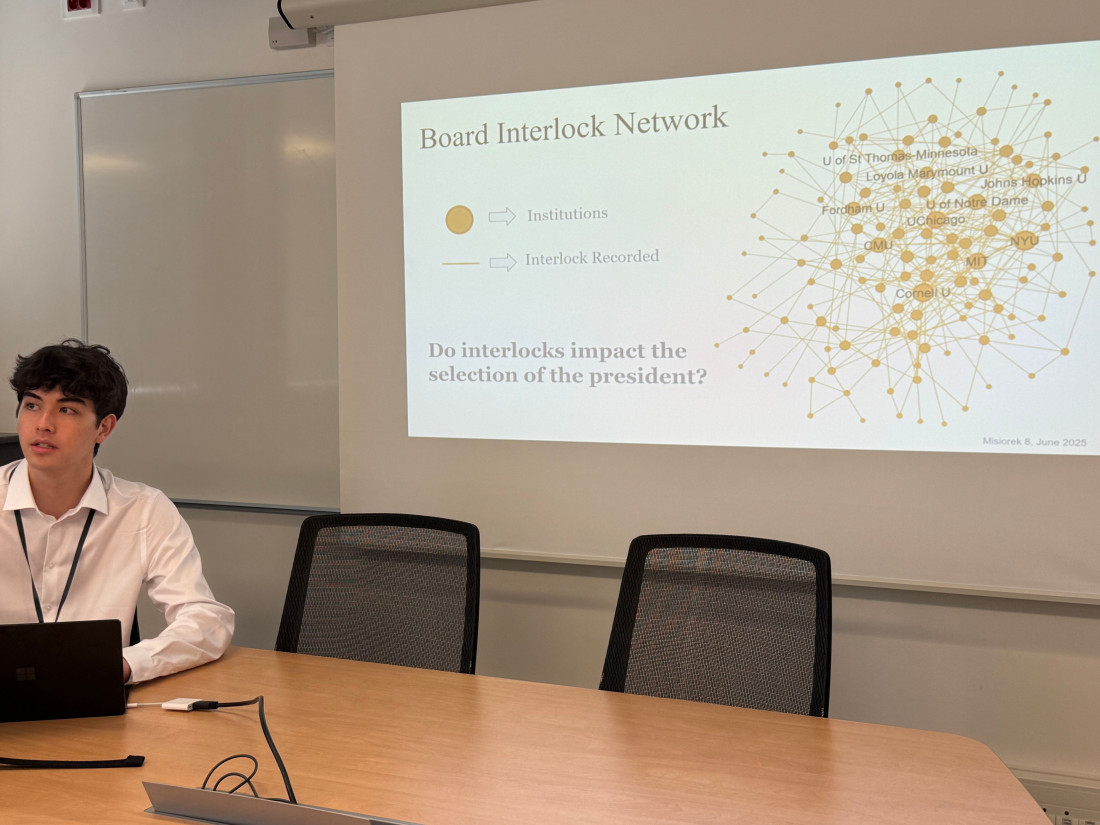
New research suggests it might be possible to map how the makeup of a university's board affects its presidency. The Connected Data Hub, led by UVA School of Data Science Assistant Professor Alex Gates, presented this research over the summer in Paris at Sunbelt 2025, hosted by the International Network for Social Network Analysis.
Ty Misiorek, undergraduate research assistant at the Connected Data Hub and a UVA computer science student, presented on behalf of the lab. The paper, "Connected Boards, Diverse Leaders: How Networks Shape University Presidencies," was authored by Gates, Misiorek, and postdoctoral research associate Jianjian Gao.
The paper examines how the makeup and social networks of university boards influence the gender diversity of presidential appointments. Using data from 179 U.S. universities between 1999 and 2018, the team found that institutions with a higher proportion of women trustees are more likely to select women presidents, even after accounting for factors such as university ranking, student demographics, faculty composition, and board size.
The researchers also found that boards with more interlocking directorates, where members serve on multiple boards, are more inclined to appoint women presidents. These results challenge the idea that leadership appointments are purely autonomous decisions, showing instead how board composition and professional networks can either promote or hinder gender diversity in academic leadership.
Gates shared what it meant for his research assistant to present their work. "It was incredibly rewarding to see Ty invited to present this work. It not only reflects the quality and rigor of his research but also signals growing interest in the kinds of questions we’re asking — about the structural influences on scientific knowledge production," he said.
Elaborating on the inspiration for this research focus, Gates explained that the Hub uses large-scale data to understand the social and organizational processes that shape scientific research. He said that recently the team became interested in how the structure of research universities influences who becomes a scientist and how research gets done.
This led the team to examine the role of university leadership in this process — boards of trustees and presidents, specifically. "The project emerged from this desire to better understand how institutional governance affects the scientific enterprise," Gates said. "Ty has done an outstanding job assembling our dataset by merging information from a wide range of publicly available sources, including university websites, archived phone books, and Wikipedia pages, to systematically identify trustees and presidents across U.S. universities."
Misiorek explained that data wrangling was the most challenging aspect of this research. "It took some effort to find a suitable source, but what we ended up with were paper-copy books (essentially phone books) that contained information about U.S. universities and the leadership and administrators at those universities, and we created a data processing pipeline to convert scanned images from the books into usable data," he said. "When analyzing the data, we saw significantly more board interlocks between universities than we expected, and our demographics summaries indicated that leadership was not very diverse."
Misiorek said that presenting the project aided in understanding the further reach of the project. "Presenting helped me view the project with more scope, pushing me to step back from the data collection and cleaning work and reconnect the work with its broader implications. The audience at the conference was very engaged, so presenting to them definitely helped me learn," he said.
Gates, who attended the conference with Misiorek, said he learned something from the experience, too. He said the experience served as a reminder of how fun it is to mentor students through open-ended and exploratory data research.
"It reinforced how essential it is to create space for curiosity-driven projects that may not start with a clear roadmap but end up generating new insights and opportunities," Gates said. "The warm reception his presentation received also highlighted a broader appetite in the research community for understanding the institutional dynamics behind science — something we’re excited to keep exploring."