Image


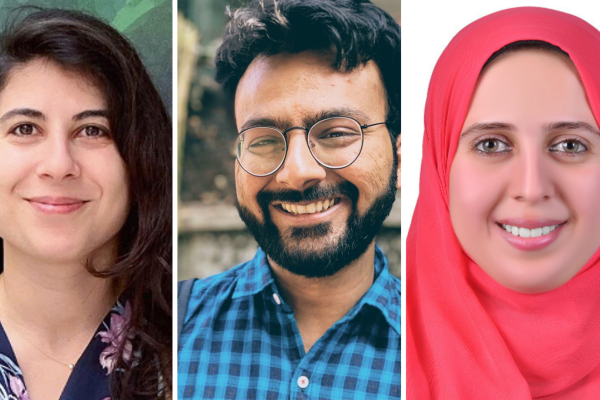
The University of Virginia's School of Data Science is excited to welcome seven new faculty in 2026, four of whom began this fall. Their research spans the philosophy and ethics of AI, machine learning engineering, cancer systems biology, social and decision informatics, biostatistics, computer vision, and human-centered recommender systems, with applications ranging from LLM deployment and wearable health data to cancer modeling, computer vision, and human-AI interaction. Read below for an introduction to each new member of the School and where their research interests lie.
William L. Polk Jr. and Carolyn K. Polk Jefferson Scholars Foundation Distinguished University Professor of Philosophy, Artificial Intelligence, and Data Science
David Danks’s research sits at the intersection of philosophy, cognitive science, and machine learning, drawing on methods and frameworks from each to address complex interdisciplinary challenges. His work spans ethical, psychological and policy questions surrounding artificial intelligence and robotics, with applications in transportation, health care, privacy, and security. He has also made significant contributions to computational cognitive science, and has developed novel causal discovery algorithms for complex observational and experimental data.
Previously, Danks was Professor of Data Science, Philosophy, & Policy at U.C. San Diego, and the L.L. Thurstone Professor of Philosophy & Psychology at Carnegie Mellon University. He has served on numerous national advisory boards, including the National AI Advisory Committee, the Special Competitive Studies Project, the National Academies’ Computer Science and Telecommunications Board, the Partnership to Advance Responsible Technology, the Center for Advancing Safety of Machine Intelligence, and the Topos Institute. His honors include a James S. McDonnell Foundation Scholar Award and an Andrew Carnegie Fellowship.

Associate Professor of Practice in Data Science
Miriam Friedel is an innovative technologist whose career has spanned both academia and industry, from 10-person start-ups to Fortune 100 companies. She brings deep expertise at the intersection of mathematical rigor and engineering at scale, and her experience delivering ML models in real world settings informs her role as an associate professor of the practice at the School of Data Science. She is particularly interested in the impact of organizational structure and leadership behavioral dynamics on the training and deployment of machine learning models, particularly with the advent of LLMs and agentic AI.
Prior to joining UVA, Friedel was a vice president of machine learning engineering at Capital One, where she led a large organization responsible for the enterprise tooling used in critical ML and AI models. She also led the replatforming of Capital One's loss forecasting framework, a crucial piece of infrastructure to pressure test economic scenarios and remain in compliance with the Dodd-Frank Act. Prior to Capital One, Friedel held roles as director of and senior scientist at Elder Research (now a MANTECH company), research scientist at the Mount Imaging Centre in Toronto, and as a consultant and software engineer at Princeton Consultants. This breadth of experience has made Friedel an expert on the entire model development life cycle. From formulating the right questions to monitoring models in production, she has a clear grasp of which problems to solve and how to solve them.

Assistant Professor of Data Science
Sarah Groves is a biomedical network scientist with a passion for project-based and analogy-driven learning. Her research focuses on building and interpreting data-driven network models that underlie cancer development, dynamics, and treatment response. After a B.S. in Physics and Mathematics from the College of William & Mary, she earned a Ph.D. at Vanderbilt University in Cancer Systems Biology in 2022, combining her quantitative background with an interest in solving biomedical problems.
As a systems thinker, Groves built computational tools to interrogate cell type switching in an extremely aggressive form of lung cancer. She then moved to Charlottesville for a postdoctoral position in the Department of Biomedical Engineering (2023-2026), where she built mathematical models to understand how proteins move and interact, or fail to do so, during mitosis in cancer.
Her interests include cancer genomics, gene regulatory network inference, civic tech, and developing innovative teaching methods.
Fun fact: "I once spent a summer working at CERN, the world’s largest particle accelerator. It’s a 16-mile underground circular tunnel for smashing particles together, on the border between Switzerland and France!"

Quantitative Foundation Distinguished Professor in Data Science, Director of Social & Decision Analytics Division and Distinguished Professor
Sallie Ann Keller, who has been a faculty member by courtesy since 2020, is a nationally recognized research scientist whose expertise spans social and decision informatics, the statistical foundations of data science, as well as data access and confidentiality.
She is a leading voice in advancing the science of all data for societal benefit. Her prior positions include chief scientist and associate director of the U.S. Census Bureau’s Research and Methodology Directorate, where she led enterprise-wide collaborations to develop innovative scientific solutions that advance economic and social measurement; academic vice president and provost at University of Waterloo; director of the Institute for Defense Analyses Science and Technology Policy Institute; the William and Stephanie Sick Dean of Engineering at Rice University; head of the Statistical Sciences group at Los Alamos National Laboratory; professor of statistics at Kansas State University; and Statistics Program director at the National Science Foundation.
Keller is an elected member of the U.S. National Academy of Engineering and the International Statistics Institute, a fellow of the American Association for the Advancement of Science, and a fellow and past president of the American Statistical Association.

Assistant Professor of Data Science
Lily Koffman is a biostatistician who develops methods to extract meaningful insights from massive and messy data generated by wearable devices and clinical monitoring systems.
Koffman’s research focuses on making high-resolution health data useful for public health research and clinical interventions. This involves creating scalable approaches for identifying individuals from their walking patterns (walking fingerprinting), rigorously evaluating step counting algorithms in large epidemiologic studies, and developing methods for analyzing hemodynamic data collected during cardiac surgery. Her work sits at the intersection of functional data analysis, machine learning, and statistical modeling, and emphasizes building efficient, open-source pipelines designed for broad use.
Koffman holds a Ph.D. in Biostatistics from Johns Hopkins University, a Master of Science in Biostatistics from the Harvard T.H. Chan School of Public Health, and an A.B. in Statistics from Harvard University.
Fun fact: "I'm from northern Maine and I learned to ski before I learned to walk."

Assistant Professor of Data Science
Cheng Peng's work focuses on enabling machines to perceive and understand the world through images and videos, particularly in unconstrained and high-stake scenarios related to health, national security, etc. Peng's research has been frequently published at major peer-reviewed venues around Computer Vision, Machine Learning, and Medical Image Analysis (i.e., CVPR, ECCV, ICCV, NIPS, ICLR, MICCAI). His ongoing research topics are on 3D/4D reconstruction, generative modeling, Vision-Language understanding.
Prior to joining UVA, Peng was an Assistant Research Professor at The Johns Hopkins Mathematical Institute for Data Science. He holds a Ph.D. in Computer Science from Johns Hopkins University and an M.S/B.S. in Electrical and Computer Engineering from the University of Maryland.

Assistant Professor of Data Science
Yeonbin Son is an assistant professor at the University of Virginia School of Data Science. Her research focuses on human-centric recommender systems, which develop recommendation models, evaluate AI performance in terms of the information quality of outputs, and design human-in-the-loop frameworks that collect human feedback to enhance AI performance.
Prior to joining the faculty at UVA, she received her Ph.D. in Systems Engineering from UVA, where she researched human modeling, human-AI interaction, and human performance evaluation. She earned her M.S. and B.S. in Industrial Engineering from Kyonggi University in South Korea, where she focused on developing machine learning-based information systems for diverse industrial fields including manufacturing, e-commerce, public policy, and healthcare.
Beyond academia, Son has entrepreneurial experience as the CEO and data scientist of Desserting Inc., a dessert e-commerce startup she founded and operated, bringing practical industry insight to her research on human-centric AI systems.
Fun fact: "When I’m not working, you’ll usually find me curled up on the couch with a book. Sometimes for the entire day."
Subscribe to receive updates from the School of Data Science.