Image

Hometown: Pohang, South Korea
Education: Ph.D. in Data Science, University of Virginia
B.S. in Physics 2021, Pohang University of Science and Technology
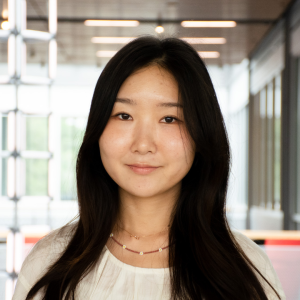
Munjung Kim has always been curious about how knowledge takes shape – within science, society, and human communities. Originally from Pohang, South Korea, she studied physics as an undergraduate but found herself drawn to questions beyond traditional physical systems.
Now a Ph.D. student in data science at the University of Virginia (UVA), Kim explores how data-driven approaches can reveal patterns in the way knowledge evolves. In this Q&A, she shares what drew her to UVA, her research interests, and her reflections on pursuing an interdisciplinary doctoral journey.
I have always been fascinated by how collective knowledge evolves within human communities, as well as by the broader question of how science itself progresses. I have also loved the methodology of physics, especially the idea of using simple mathematical models to describe complex systems, but I found myself less interested in the traditional physical systems studied in that field.
Toward the end of my undergraduate studies, I discovered the areas of computational social science and science of science, and realized I could apply data-driven, physics-like approaches to understanding human systems. The idea of using big data to uncover simple patterns in complex social or scientific dynamics is what drew me to data science.
I chose UVA's Ph.D. in Data Science because I was excited by the opportunity to grow in a new environment and to work at the intersection of many diverse fields.
I'm particularly drawn to the science of science, as well as related areas like the philosophy and sociology of science. I've always been fascinated by meta-level thinking, reflecting on how knowledge is produced, organized, and evolves over time. My interests also extend beyond formal scientific domains to the broader evolution of knowledge itself, including how ideas emerge in society more generally.
I hope to continue in academia, although it will ultimately depend on the opportunities and circumstances at the time.
I think one of the most important things for anyone considering a Ph.D is having confidence in your motivation and enthusiasm to see a long-term project through. It's a challenging journey, so having a strong internal drive really matters. That said, I'm still in the early to middle stages of my own Ph.D., so I know I have a lot more to learn along the way!
My initial impression of the school is that it brings together a highly diverse range of disciplines, creating a rich and completely new environment, unlike anything I've experienced before. The faculty seem incredibly supportive. I'm especially excited about gaining new perspectives by learning from peers across different fields.
At the same time, I anticipate that interdisciplinary communication may be a challenge, as each field has its own terminology, norms, and ways of thinking. Still, I believe that finding common ground across disciplines can lead to truly creative and impactful collaborations.
There was a year I lost my phone 10 times. I have just two upper incisors.
Subscribe to receive updates from the School of Data Science.