Image

Employment
Visa, Consulting and Analytics Manager (Washington, D.C.)
Education
M.S. in Data Science 2025, University of Virginia
MBA 2025, University of Virginia
B.A. in Media and Cultural Studies, Minor in Data Science 2019, Macalester College
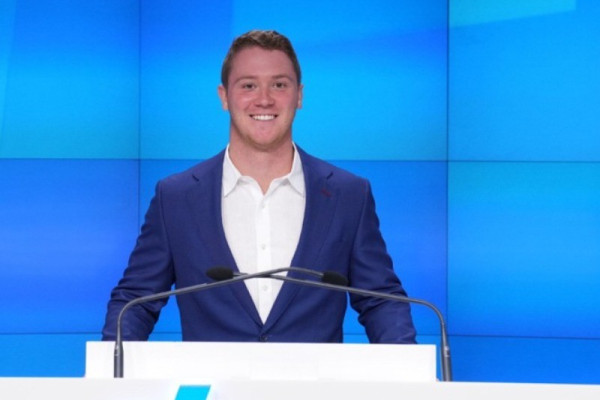
For Will Milch, the decision to pursue the dual MBA/M.S. in Data Science (MSDS) degrees at the University of Virginia (UVA) was about more than expanding his technical skills – it was about learning to think differently. At the School of Data Science, Milch found a collaborative community where conversations with classmates often sparked new ideas and challenged him to approach problems with creativity and curiosity. Through coursework, capstone projects, and late-night study sessions, he developed both the technical toolkit and the strategic mindset to thrive in a rapidly evolving field.
Now a Consulting and Analytics Manager at Visa in Washington, D.C., Milch helps financial institutions make sense of complex data and design strategies that meet the needs of their customers. He credits his time at UVA with preparing him not only to analyze data, but also to communicate its value to diverse audiences, from engineers to executives. Looking ahead, he hopes to tackle one of the biggest challenges facing the tech world today: building trust in AI systems and ensuring accountability in the algorithms that shape daily life.
Read on to learn how Milch’s UVA experience shaped his career path, the mentors and projects that made a lasting impact, and why he believes trust must be at the center of our digital future.
While I'm still settling into my full-time role, I can say from my experience during my internship that I leverage the power of Visa's data to provide value to our clients in the Financial Services space. We perform strategic engagements to help our clients answer their toughest questions and stay ahead of the curve. For example, I have helped different Financial Institutions develop a stronger sense of their cardholder behavior and determine where to augment their reward offerings.
Through the MSDS program, I learned a broad swath of algorithms and statistical models, but more importantly, the critical thinking and high-level perspective that allowed me to think clearly about how to use all of the cool technical stuff I learned. We talked a lot about the entire data pipeline, taking an idea to a testable hypothesis through collection and analysis, to communicating results to a broad set of stakeholders. In terms of what I wish I had learned, the thing about this field is that innovation happens so quickly that it takes a lot of work just to keep up, which is part of the fun.
Getting to work with the U.S. Census Bureau on my capstone was a really transformative experience where I got to see firsthand how to manage a real project for an organization with a ton of impact. I worked with an incredible team that got to design a plan to help transform Census data to make it more usable for everyday practitioners. We met frequently with the team at the Census Bureau to fine-tune our solution to what they needed. That team-based collaboration is the basis of my work at Visa, and I'm incredibly grateful for the Bureau's collaboration and close partnership during our capstone.
Professor Jon Kropko's Practice and Applications of Data Science was a great intro to what it's like to be a real data scientist. I remember several assignments where we were given very unorganized or broken datasets, and our assignment was simply to turn them in cleaned. While there were so many complicated and technical approaches I picked up throughout the program, a big lesson I learned was the creativity and resolve it takes to deal with real challenges.
It was invaluable to talk with alumni of the program and hear from them how they positioned the skills they acquired in a business context. It's very different to demonstrate your coding skills to a specific audience than to describe the data-driven strategy as to why you would build something in a particular way. As I talked with different companies, UVA alums were very eager to talk with me and help me as best they could.
As AI and machine learning become increasingly central to every industry, the MBA/MSDS combination degree has opened a lot of doors. It signaled to everyone both that I had technical proficiency, but also the ability to think critically about how data fits into real-world decisions. interviews, mentorship, and rooms where strategy and data meet. I was given the vocabulary for communicating with both engineers and executives, and being able to bridge that gap is powerful.
There are so many memories I have of the collaborative atmosphere in the common room, when I felt like I was able to talk with someone anytime. I was struck by the beautifully nerdy conversations where I learned something that blew my mind and helped me become a better student.
I want to help solve the growing challenge of trust in our algorithmic world. As AI systems and LLMs shape more of our lives, frameworks that ensure transparency, accountability, and confidence in the systems we rely on daily will become essential. Drawing from lessons from classes, including our ethics course, my goal is to help create technologies and systems that make trust a bedrock feature of our digital world.
Learn more about the full-time, in-person Residential MSDS at the University of Virginia. Request more information, connect with Admissions, or start your application today.
Subscribe to receive updates from the School of Data Science.