Image

Employment
Booz Allen Hamilton, Data Science Analytic Methodologist (Springfield, Virginia)
Education
M.S. in Data Science 2020, University of Virginia
B.A. Statistics 2019, University of Virginia
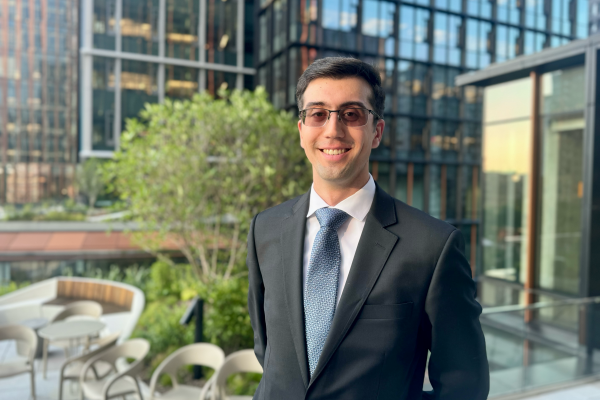
Logan Lee has built a career at the intersection of analytics, consulting, and public service — and it all started at UVA. A double alumnus who completed both his undergraduate degree in statistics and his M.S. in Data Science (MSDS) at the University of Virginia, Lee credits the MSDS program with building the versatile foundation that made his rapid career growth possible.
Since graduating in 2020, he has applied the technical and communication skills he developed at the School of Data Science across two high-stakes environments: first as a forensic data analyst at Ernst & Young, and now as a data science analytic methodologist at Booz Allen Hamilton. In the Q&A below, Lee reflects on what client-facing data science work actually looks like day-to-day, how the capstone experience shaped his consulting instincts, and why the moment we're in with AI and LLMs feels unlike anything before.
Before joining the MSDS program, I was an undergraduate student studying statistics at UVA, where I was already aiming to transition into a data science role. The MSDS program bridged that gap and accelerated my career entry. After this program, I accepted a position as a forensic data analyst at Ernst & Young. This foundational training paved the way for my current data science role at Booz Allen Hamilton.
As a data science professional supporting the federal government, my day-to-day work centers on close client interaction. Across any industry — whether big tech, healthcare, finance, or the federal sector — you cannot perform impactful analysis or present meaningful deliverables without deep domain knowledge. A large part of my day involves communicating with clients and collaborating with fellow data scientists to pinpoint the core problems an organization is trying to solve and understand why they matter.
Because project timelines vary from rapid turnarounds to multi-month initiatives, my daily routine is highly dynamic. On any given day, I might spend hours writing scripts to build robust data pipelines, facilitating client meetings to present key insights, or dedicating time to technical training to master new tools.
The capstone project was a pivotal experience for me. It taught me how to effectively manage client communication, navigate technical bottlenecks, and structure solutions around the business questions. In consulting, a significant challenge is translating highly complex models into actionable insights for a non-technical audience.
Even if you understand exactly how an advanced architecture like a neural network operates under the hood, that does not guarantee your explanation or recommendation will be accepted by the client. The capstone program mirrored this reality perfectly. It taught me how to bridge the gap between deep technical execution and impactful client delivery, a skill I use every day at work.
The School of Data Science's "A School Without Walls" philosophy is what originally drew me to the program. Now that I am working, I see that this concept holds completely true across both industry and government. The program focuses on building a versatile foundational toolkit. Because data science is inherently interdisciplinary, mastering these core methodologies makes it seamless to transition across different domains, projects, and client spaces.
The widespread adaptation of AI and LLMs is incredibly exciting. We are seeing a massive shift across federal agencies as they transition from isolated pilots to deploying complex, agentic AI models directly into their mission pipelines. What makes this era unique is that AI is no longer a tool reserved exclusively for data scientists or technical personnel; it is actively augmenting day-to-day operations for non-technical stakeholders across the public sector.
However, significant challenges remain, particularly surrounding model hallucinations and erroneous outputs. This stems from a historical shortage of frontier models specifically trained on secure, highly classified data. As major enterprise tech companies increasingly scale tailored AI architecture and defense-specific solutions into secure enclaves, I am eager to see how rapidly these secure models will mature, eliminate accuracy bottlenecks, and redefine mission capabilities in the near future.
Mastering the course material and earning good grades represents only half of the MSDS experience. The remaining half relies on building and maintaining a strong professional network. Building deep relationships with your cohort, alumni, and colleagues is critical when transitioning into the professional world.
Data science is not a monolith; every sector operates differently, utilizing distinct methods, enterprise systems, missions, and objectives. You will gain massive amounts of industry knowledge simply by speaking with professionals working on projects outside your immediate scope. Embracing these conversations gives you a macro-level understanding of where the industry is moving, which is an incredibly valuable asset for your career.
Learn more about the full-time, in-person Residential MSDS at the University of Virginia. Request more information, connect with Admissions, or start your application today.
Subscribe to receive updates from the School of Data Science.