Define the Data Scientist You Want to Be with Collaborative Concentrations
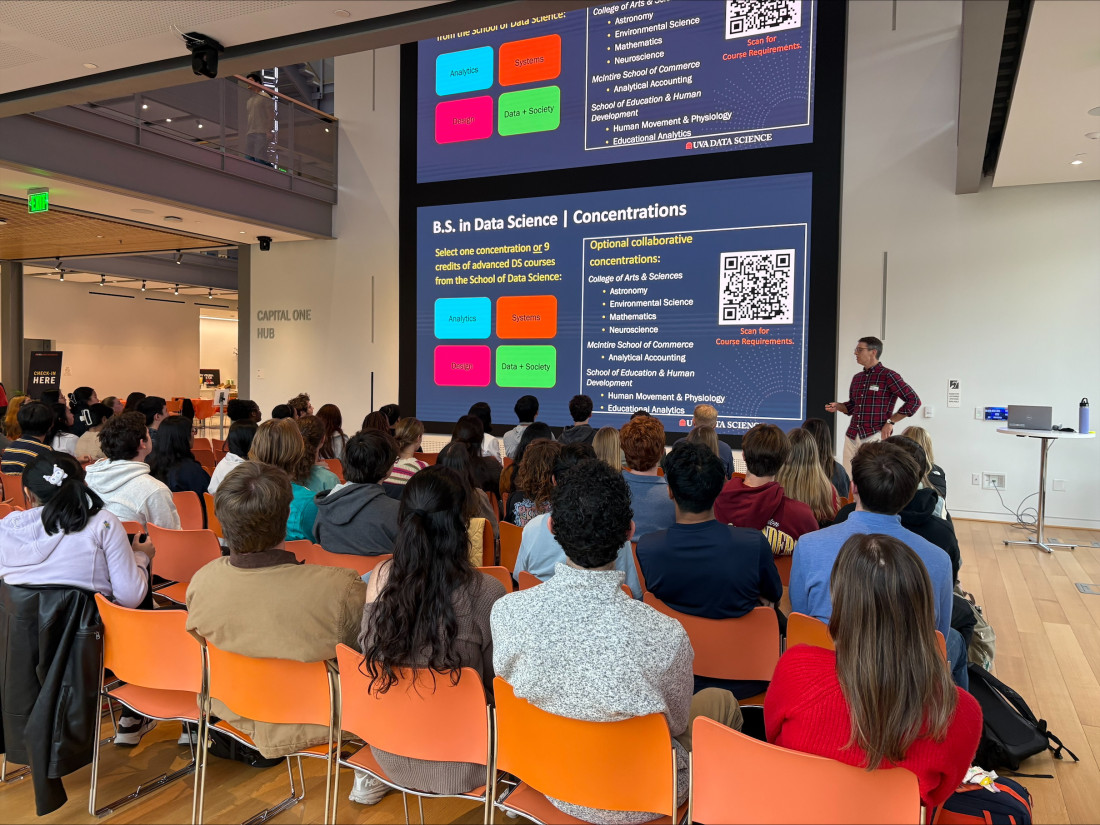
For many students entering the B.S. in Data Science (BSDS) program, one of the most exciting parts is customizing their degree with a collaborative concentration. With data science touching nearly every industry, the possibilities feel endless. To bring clarity, the School of Data Science hosted its first Collaborative Concentration Night, designed to help students explore connections between data science and fields across the University of Virginia (UVA).
The evening featured faculty and advisors who explained how concentrations (and associated research labs) fit into the BSDS curriculum. Students learned about the four core concentrations within the School — Analytics, Systems, Design, and Values — as well as collaborative concentrations that link data science to current and in-development disciplines such as Human Movement and Physiology, Public Policy, Economics, Environmental Science, Education, and Astronomy, among several others. Together, these pathways help students shape an academic experience aligned with their interests and future impact.
Connecting Passion with Academic Direction
For second-year student and BSDS Ambassador Max Farnham, the event shifted his perspective on his future in data science. He shared that the night “turned my nerves into excitement about what’s ahead,” noting that seeing employment projections and real job growth data helped him “feel confident that meaningful opportunities are waiting, even if I’m still deciding where to focus.”
That feeling was echoed by many in the room. As BSDS student Zoe Tankersley put it, data science can sometimes feel overwhelming “because of how vast the possibilities are,” but hearing specific industries and roles where data expertise is needed “gave me a sense of clarity.” The collaborative model, she said, gives students “specific interests to lean into” as they move forward through the program.
“Hearing concrete industries and job titles gave me clarity in a field that can sometimes feel overwhelmingly vast.” –Zoe Tankersley
Real Conversations With Real Impact
In small-group conversations, faculty advisors and concentration leads walked students through potential course sequences, research opportunities, and internships tied to each path. Heath Miller, a BSDS student and member of the Air Force ROTC, said these conversations helped him understand “different research and internship pathways that can guide me to future jobs, as well as a variety of working environments that I may be interested in.” He left with renewed interest in the Astronomy concentration, seeing a way to align personal passion with technical skill.
For BSDS student Kate DeForrest, who is pairing data science with a minor in Education, learning about Educational Analytics helped her recognize how data can drive meaningful change in classrooms. The concentration, she said, “will expand the ways in which I can have a real human impact that will help someone with the work I do.”
“I learned about research and internship pathways that can guide me toward jobs and working environments that fit my interests.” –Heath Miller
Career Pathways: Turning Concentrations Into Opportunities
Second-year student, BSDS Ambassador and Army ROTC cadet Audrey Stelle appreciated the chance to hear directly from leaders and advisors who support BSDS students from day one. She said the event “gave me a much better idea of what the different concentrations mean and how they can shape future career paths,” especially as she explored options like Environmental Science and Public Policy — areas where data science plays a critical role in solving complex global challenges. “I’m still not sure which concentration I want to choose yet,” Stelle admitted, “but it was exciting to explore all the possibilities and see how many directions this program can take me.”
Beyond helping students choose an academic direction, Collaborative Concentration Night also offered a clear look at how concentrations translate into professional opportunities. Stephanie Joynes, Assistant Director for Career & Professional Development at the School of Data Science, led a session focused on how employers evaluate candidates and the skills that matter most in the job market. She emphasized that while technical skills such as SQL, R, and Python are essential, companies are equally looking for communication, teamwork, professionalism, and adaptability.
Joynes encouraged students to view their concentration as a signal of their interests and goals — not a limitation. “Your data science major is one part of the entire person they are hiring,” she noted, highlighting that employers value individuals who can articulate their passion and apply their skills across contexts.
Support to Explore, Confidence to Choose
By the end of the night, the sense of uncertainty that often accompanies early academic decisions had been replaced by energy and confidence. Students left with a clearer understanding of how their coursework can reflect their strengths, passions, and aspirations — and with a strong support system to help guide those choices.
Collaborative Concentration Night made one thing clear: there is no single path through data science. Instead, the School of Data Science encourages students to shape their own — one informed decision at a time, and with the full support of a community committed to their success.